


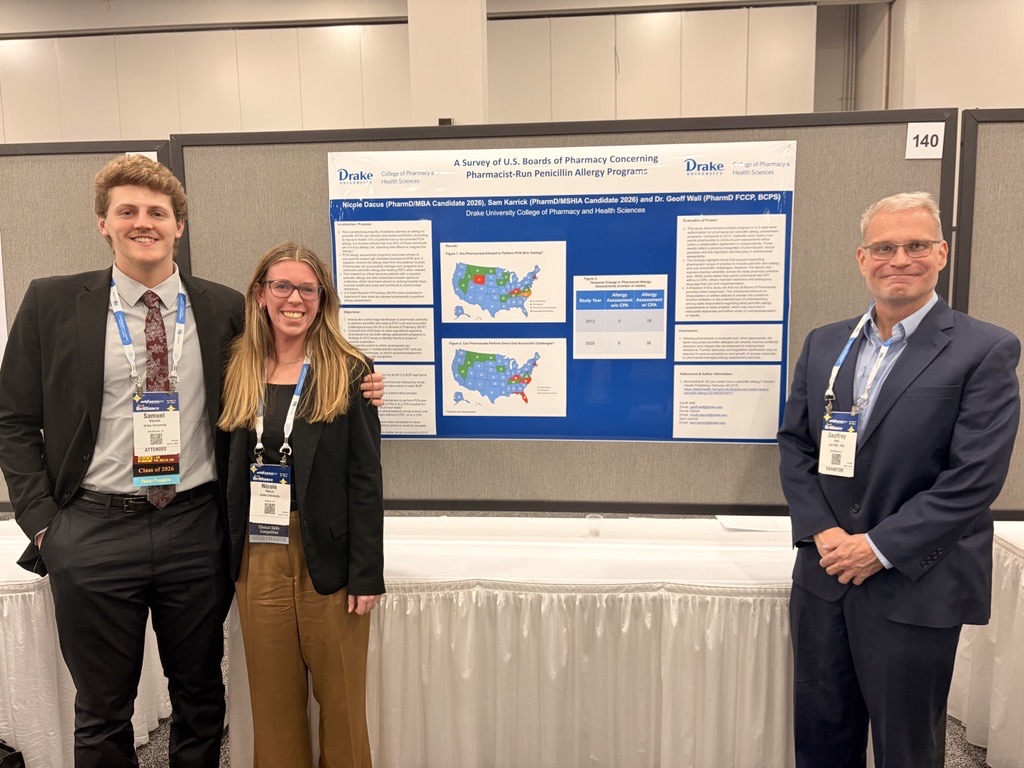
Five Drake pharmacy students presented research posters at the annual American Society of Health-System Pharmacists (ASHP) Midyear conference in Las Vegas, NV.
The ASHP Midyear Clinical Meeting is one of the largest events for those in the pharmacy profession, with over 20,000 attendees every year from across the globe and nearly 1,800 student posters.
“Attending ASHP Midyear and presenting research was incredibly important for my professional development,” said Elaina Hines, PharmD Candidate 2026. “It helped to strengthen my public speaking skills while allowing me to discuss a topic I am passionate about.”
Alongside faculty mentors, Drake students explored issues facing today’s medical professionals, including:
What medication packaging is most efficient in a long-term care setting?
Mackenzie Beam, PharmD Candidate 2026, pharmacy faculty member Dr. Kristen Meyer, and Matthew Fook, PH’25, researched the efficacy of bubble packaging versus strip packaging in long-term care facilities. Their study, Streamlining Medication Administration: Assessing the Impact of Types of Medication Packaging on Nursing Efficiency in Patient Care, found that nurses were able to administer bubble-packed medications more quickly than strip-packed pills.
Can non-diabetic college students benefit from continuous glucose monitoring?
Hines presented research conducted with fellow P4s Madelynn Aeilts, Kristen Alford and Elise Young, and faculty mentor, Dr. Wendy Mobley-Bukstein. To better understand the clinical uses of continuous glucose monitors (CGMs), a group of pharmacy students wore the devices over 20 days. Participants measured their A1C on the first day of the study, and then again 90 days later.
In their paper, Hemoglobin A1C vs. GMI in College Students without Diabetes, Hines et al. found that participants had a statistically significant difference in their A1C and GMI values at the end of three months. Although further study would be necessary to assess the value of glucose monitoring among non-diabetic individuals, all participants in the study said the CGMs “provided valuable perspective into the daily lives” of people with diabetes.
How can medical providers screen for depression among pregnant and postpartum women with opioid use disorder?
Jothsana Jaimon, PharmD Candidate 2027, collaborated with members of the Thomas Jefferson University College of Pharmacy to explore the underlying factors that may contribute to depression among pregnant, recently miscarried, and postpartum women with opioid use disorder.
Exploring Predictors of Depression Among Pregnant, Recently Miscarried, and Postpartum Women with Opioid Use Disorder: A Cross Sectional Survey revealed that miscarriages, inadequate emotional support systems, and overdose experiences were strongly associated with more severe depression among this population.
“This underscores the urgent need for tailored interventions, including enhanced social support systems and proactive depression screening and treatment, with particular attention to those who recently overdosed or miscarried,” Jaimon et al. wrote.
How significant is the risk of neutropenia resulting from schizophrenia medication?
The Food and Drug Administration (FDA) requires medications with potentially severe side-effects to be closely monitored through the risk evaluation and mitigation strategy (REMS) program. Until recently, clozapine – a medication for treatment-resistant schizophrenia with suicidality – was on the REMS list due to risk of severe neutropenia, a disorder that can lead to fatal infections.
The FDA removed the REMS protocol in 2025. Stacy Johnson (PharmD Candidate 2027), Dr. Jenna Rose and Drake pharmacy professor Dr. Lynn Kassel reviewed patient charts to determine whether neutropenia was an acute risk among clozapine users. Of 89 subjects, just one was neutropenic for a single day while in the health system.
“These findings suggest that the discontinuation of the REMS program for clozapine does not compromise patient safety, and routine monitoring may be safely reduced or tailored in inpatient settings,” Johnson et al. wrote.
Do longitudinal research projects contribute to pharmacy residency burnout?
Basil Elayadom (PharmD Candidate 2027) presented a poster about burnout among postgraduate pharmacy residents. Alongside co-authors Dr. Anna Shook, faculty mentor Dr. Eliza Dy-Boarman, and Jared Butler, PH’11, Elayadom created a questionnaire for pharmacy residents in the Midwest.
Pharmacy residency programs require participants to complete a yearlong research project in addition to patient-care tasks. The survey aims to identity areas of friction within this project: What is contributing most to feelings of stress among residents?
In which states can pharmacists test for penicillin allergies?
Fourth-year Pharm.D. candidates Nicole Dacus and Sam Karrick worked with faculty mentor Dr. Geoff Wall on a poster entitled A Survey of U.S. Boards of Pharmacy Concerning Pharmacist-Run Penicillin Allergy Programs. In some states, pharmacists may perform allergy assessments, including penicillin allergy skin testing. These tests can determine whether a patient with a self-identified penicillin allergy could safely tolerate certain antibiotics.
The research team contacted all 53 U.S. Boards of Pharmacy about the state laws governing this practice. The survey found that 37 states allow pharmacists to perform an allergy assessment – a significant increase from the 23 states that allowed such programs in 2003.
“Overall, the results highlight the growing clinical role of pharmacists and the importance of consistent legislation to support antimicrobial stewardship,” Dacus said.
In addition to the student poster presentations, Professor of Pharmacy Practice Sarah Grady led an educational session about the effects of antidepressant drugs on glucose levels.